Return to Raleigh

Back on the Raleigh today after nearly a week breaking in the bakfiets. Riding to work felt like I’d stepped out of the on-deck circle and slipped the donuts off my bat. The old steel of the Raleigh rode like it was built for the Tour in comparison.
I like to talk about frame weight as a non-issue in order to emphasize how low on the list of priorities it should be when choosing a practical bike. Nobody commutes for speed, so if you’re talking about frames, you should be talking about what will last. What can I park outside all day in the rain, ride home through salty slush, and still have ticking thirty years later? (There’s a side conversation here when people ask, “how do I carry that bike up stairs?” which I’ll eventually write about. For now, the short answer is: start thinking like the Dutch. They use expensive locks and they keep their bikes outside, day and night.)
That’s not to say, however, that frame weight doesn’t ever make any difference. Compare the bakfiets to, well, anything, and you’re going to have a quicker, more nimble riding experience. Nor is that to say a given frame material necessarily dictates how a bike will ride. My road bike is also steel, but it’s built with modern tubing which hardly compares to the tubing of the 70’s on my Raleigh. I’ll take a picture sometime to show you the difference; steel forging has evolved to the point at which modern tube walls are many times thinner and the butting stronger than on the old tubes. That means a steel road bike can feel as quick and nimble as a carbon fiber frame while being only slightly heavier but many times more durable.
Still, if you want a bike for utility, this conversation should be at the periphery. Don’t worry about what it weighs. Worry about whether you feel comfortable on it and whether it will last as long as you ride (which is hopefully forever!)
Filed under: commute, My Bike, Useful Things, Winter | Leave a Comment
Tags: bakfiets, bicycle, bike, carbon, frame, Raleigh, steel, weight
A bike should never squeak
Oil your chain. You’ll feel better!
Filed under: Useful Things | Leave a Comment
Tags: bicycle, bike, chain, feeling good, oil
 The fancy/weight rule states that as the cost and/or mass of a vehicle increases, its driver cedes proportionally more culpability for his or her actions on the road, with a special obliviousness reserved for cyclists. I found myself unwittingly in a proof last Thursday night when a certain Mr. Porsche cut in front of me to make a left turn; he had arguably not enough time nor space in which to do so. Extra points go to him for being on the phone. I’m 90% sure he was eating a sandwich in the other hand.
Assign whatever classist reasoning you want to this argument. Clearly, your car doesn’t have to be big or expensive for you to drive it poorly. And I don’t mean to suggest that every last SUV driver takes pains to make cyclists’ lives uncomfortable. But one data point on this graph is infallible. It’s at the intersection where the two curves of cost and weight converge: Range Rover drivers are the worst.
Filed under: Try not to do this, Useful Things | 1 Comment
Tags: 911, audi, bicycle, bike, civic, gmc, honda, porsche, range rover, yukon
Three Schwinns in Brooklyn
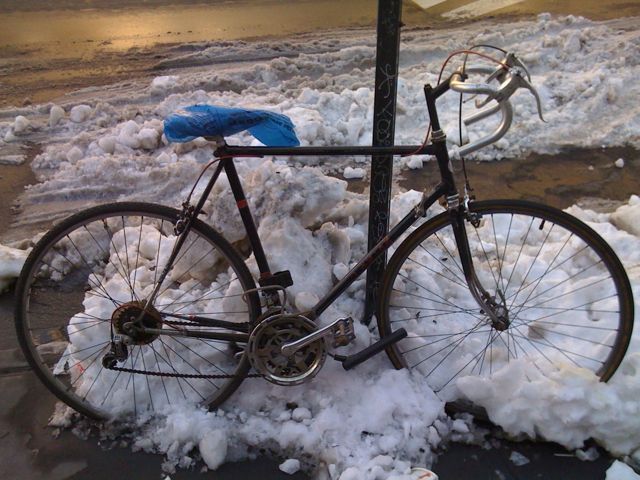
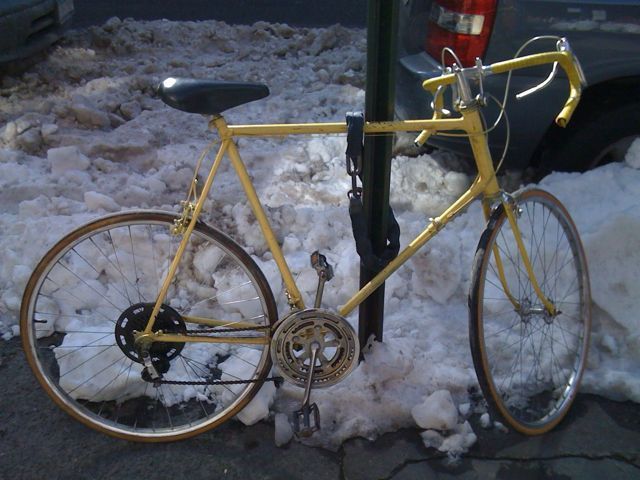

Filed under: Schwinn, Winter | 2 Comments
Tags: bicycle, bike, Brooklyn, Schwinn
The big snow
The big snow missed us this time. We got a handful of inches. But first we got wet stuff, which promptly froze under the snow. My ride to work was on a five-mile sheet of ice. I went extra slow and I rode the heavy bike, the bakfiets. I wanted to see how it would do. After the first corner, the rear tire skidded out from underneath me, but I caught myself right away. A skid like that on my Raliegh and I would have been on the ground. But the bakfiets has a highly sloped seat tube, which puts the rider in a position to put a foot down without any effort. I didn’t even have to think about it. I’d instinctively put my foot out and the bike didn’t tilt over much before I was standing.
The rest of the ride was purposefully slower and nearly traffic-free. I left extra early to give myself time, so the combination of that and the bad roads kept the cars away. By the afternoon, everything on the roads had melted and my ride home was uneventful.
Later, I went over my mother-in-law’s to shovel her drive and walk. Here is where the bakfiets takes the place of a car. I needed to bring our snow shovel. I would have spent far too long considering how I could bungee it to the rack of my Raleigh, if I could at all. But with the bakfiets, I put it in the box and I leave. That’s it. Just like a car—you don’t think about how the shovel will come with you, you simply put the shovel in and you go. It’s the ease that makes it work. Bikes should not be hard.
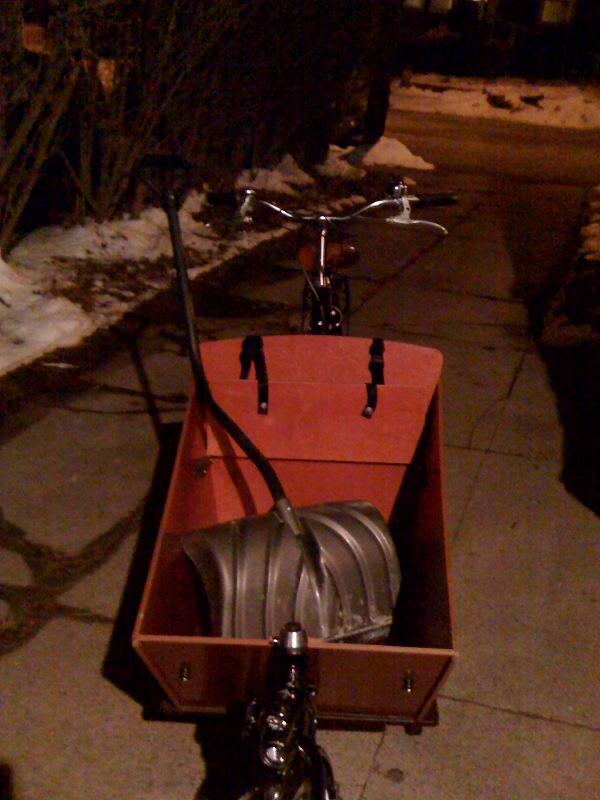
You also get past scraping up the box and dinging the paint. This is a bike meant to work and sit outside all year in the salty air. As Henry Cutler has said, they’re “not spring flowers.” I used to be pretty fussy about my bikes, but all I do anymore is clean the salt off my Raleigh when winter is over and wipe my chains when they get too gritty. They don’t need much more than that. This bike needs even less.
Filed under: bakfiets, My Bike, Winter | Leave a Comment
Tags: bakfiets, bicycle, bike, car, ice, shovel, snow, Winter
A red Schwinn with a banana seat
A red Schwinn with a banana seat, maybe a Stingray. That was my first bike, the bike on which I had training wheels. I don’t remember it having high handlebars though. My brother’s bike was a blue Stingray, for sure. Great seat on that one. Schwinn called it a “bucket saddle.” I wonder what an adult version would ride like. My mom had a blue three-speed Suburban and my dad had a brown ten-speed Varsity. I clearly remember the Schwinn dealer, down 28th Street next to the Dunkin’ Doughnuts. I don’t remember if they originally sold only Schwinns, but they eventually began stocking Treks in the early 90s when Schwinn was well on its way to die.
I had outgrown my Schwinn by then, so I got a Trek. I was completely taken by the whole mountain biking thing—I obsessed over the 8000 model because it was aluminum and looked totally kick-ass. I got the 820. Pretty sure I never took it off-road. I brought it to college. I didn’t know anything about quick release skewers or how to lock up a bike, so my rear wheel was promptly stolen. I had it replaced. I brought it home at the end of the year. My enthusiasm had waned. I didn’t take to riding in college.
Then I didn’t have a bike for a pretty long time. It wasn’t until 2001, after I’d been living in New York for a while that I started thinking about bikes again. I did a lot of reading. Wasn’t nearly as much online as there is now (glad to see it growing) but one guy was out there, dutifully building an encyclopedic knowledge of bicycles. He was Sheldon Brown. He knew at least a little bit about everything you could possibly want to know about bikes and a great deal about most all of it. He would answer every email I sent him. His site was what convinced me to get a 3-speed Raleigh for riding around New York. It is still an indispensible resource.
So I went on a hunt for a Raleigh and discovered that New York shops keep just about zero in stock. If they ever show up used, they disappear that same afternoon. Clearly the next best thing was to drive to Philadelphia to get one. If you live there, visit Trophy Bikes. I think they’ve moved since I was down nearly ten years ago, but in their old shop they kept the Raleighs in the basement. It was actually kind of charming. The shop was open and well-lit, a Brooks display right past the counter. Good looking stuff in there. You wouldn’t have guessed they had bikes for sale down in that dank cellar, but there they were, maybe a half dozen of them.
I think it cost $250. It had its original Brooks and it was as stiff as bare plastic. It was an incredibly uncomfortable test ride because of that saddle, but I was sold on it anyway. I got it back to New York. I got a new Brooks. I had the wheels rebuilt to replace the steel rims with alloy (steel rims + rain = your brakes will never, ever work). I got a rack and a Cateye light and a Planet Bike blinky, too. It was great. I loved riding that thing all over the city.
I rode it over the Brooklyn and Manhattan bridges (never got to the Williamsburg). Rode it down to Battery Park and the west side path all the way up to the GW. I used to love getting tamales in Washington Heights the year I did Team in Training. My friend Megan and I would eat them on the street before swim practice. Not the smartest training food but unquestionably the most delicious.
I rode the East River path. Rode it to Queens to the Hells Gate Bridge. I rode in the Five Boro Bike Tour twice. The first time was incredibly fun and I have great memories of it. It was so good, I felt compelled to recruit Sarah and our friends Jeff and Sarah the next year. It rained half the day that year. Then Sarah and Sarah were hit by a guy who mistook the biggest leisurely ride in the country for a race. And when all thirty thousand of us lined up in Staten Island to take the boat home, we found only one was running. Both ways. We stood in the sun for hours. I never did it again. (And I may have killed cycling for all three of them).
I rode to work. I road to Houston and Broadway. I rode to Times Square. I parked for a time on an indoor rack at the 1515 building. Not many indoor bike facilities back then. It was nice. I rode at night. A lot. Riding at night is probably my favorite thing to do on a bike. There is no traffic. Everything is quiet. You can relax a little. It’s like Amsterdam all the time. I miss New York for that.
Filed under: My Bike | Leave a Comment
Tags: bicycle, bike, Five Boro Bike Tour, New York, night, Schwinn, Stingray, Suburban, Trek, Varsity
First ride
We had a snow day from work. Only the snow didn’t come until late in the day, so we set the kids off on their first ride to pick up blizzard supplies from Nana, like dutiful New Englanders.


R was smiling long after he came inside and G fell asleep on the way home. It was a resounding success. We are ready for the winter farmer’s market and the children’s museum. We will be getting out of the house together and keeping our sanity alive until spring. Everybody wins.
The bike is just as nice with two toddlers as it is with a hundred pounds of groceries. Stable, quiet, like a locomotive coasting on tracks. I’m still amazed by how balanced it is. It could be ridden no-handed if the steering weren’t so sensitive. That has taken a little getting used to. It needs very little input to move the front wheel.
You may have noticed in the photos our other car—a Honda Element. We lived for ten years in New York nearly car free and it was perfectly lovely. We had a car near the end of our time there, but only ever really used it to get out of town or to Home Depot. It was often more a chore than it was worth, as anyone who has parked in that city well knows. Between alternate side every few days and the weeks during which the city looked to boost its revenue by towing everything in sight, we had our fair share of pain owning the thing.
We eventually left New York and moved to a much less dense city, but a city nevertheless. Dense enough to make cycling practical—and lucky enough to find jobs near enough that we don’t need to drive to them—but not the kind of density that supports car-free living. That list you can count out on one hand: NY, SF, Boston, Chicago, Philly. Maybe Portland and Seattle, but the public transportation infrastructure really drops off after the first five (and Philly can be counted as a stretch).
So we needed a car. Neither of us ever thought we’d end up with an SUV, but the other model we considered, the Fit, was just too small to support an old house and infant twins. After hauling five loads of replacement windows one fall, I never thought about it again. It meets our needs and it fits into tight spaces and we put relatively few miles on it (and it gets the same mileage as an Outback, which is the de facto standard around here) so we’re fine with it.
All that is a roundabout way of saying I hope to put even less miles on it now that we have the bakfiets. We have myriad places to go with the kids that we can reach by bike, not the least of which being two waterfront cycling paths which take us past relatives’ houses and picnic spots. Summer can’t come soon enough.
Filed under: bakfiets, Kids, My Bike, Useful Things | Leave a Comment
Tags: bakfiets, bicycle, bike, Kids
Our second car…

… is a bike! It’s a Dutch bike and it’s called a bakfiets, which translates literally to box-bike. (Quick Dutch lesson: fiets = bike. That’s the singular. In Dutch, the suffix -en denotes the plural, the same way in English we say ox and oxen. So: many bikes are fietsen; many boxbikes are bakfietsen. Bike path = fietspad. Now you can move to the Netherlands, you’re welcome!)
Yes, it is huge and heavy, in the neighborhood of 100 lbs. You will not pass anyone going uphill on this bike. It has a capacity of more than twice that, in the box and on the rack, which is strong enough to hold someone riding sidesaddle. I took it to the grocery store tonight and did a week’s worth of shopping. I made it back up the 6% hill to our house, but the head lamp was flickering at times because I was moving so slowly. It took a lot of effort, but the bike never strained. It is surprisingly balanced, loaded or not.

I had initially thought I would want to lower the gearing with a larger cog in the back, like I did with my 3-speed for the hills around here, but no higher cadence was going to move things any faster. It is an exercise in patience, riding a load up a hill, and that is the trade you make for a bike that can do it.
Didn’t get the kids in it right away because I wanted to get accustomed to things first and it was already late in the day. Tomorrow we’re getting a thousand pounds of snow and this weekend we’re out of town, so they’ll have to wait until next Friday.
Filed under: bakfiets, Dutch, My Bike, Useful Things | 3 Comments
Tags: bakfiets, bicycle, bike, Dutch, groceries
Shopping
Done. Package delivered to the post office.

Filed under: shopping, Winter | Leave a Comment
Tags: bicycle, bike, shopping
Bars up, pt. 2
That’s one way to do it!

Filed under: handlebars, Uncategorized | 1 Comment
Tags: bicycle, bike, handlebars
 Bikes Can Work