Funny Bunnies

Happy Bunny Day. The snow melted long ago and we’ve been out, just haven’t had much chance to write about it. Will be catching up one of these days…
Filed under: bakfiets, Kids | 1 Comment
Tags: bakfiets, bicycle, bunny, funny, Kids
Upright, con’t.
In fairness to Todd, I feel I should clarify my earlier hyperbole.
Other riding positions undoubtedly have plenty of usefulness. Even cycling gear has great usefulness*. I own spandex shorts and clipless peals and shoes and a mirror that attaches to the visor on my road helmet. I have no desire to ride 90 miles in jeans to prove a point. I was using hyperbole to emphasize just how far we have to dig ourselves out from under the ruin in which racing and technology in cycling have buried practical usefulness. If you read widely about urban cycling, you’ll see that theme repeatedly. You don’t need a lot of stuff to ride a bike, just like when you were a kid. But you wouldn’t know that when you visit most shops. You certainly wouldn’t know that from most group rides.
When I write in this space, I’m writing exclusively about city riding: commuting, errands, shopping, kid transport. Very little I do in that context happens over 10mph; very little happens outside a 5-mile radius. With that in mind, then: Yes, I think fully upright is by far the best way to go. No, I don’t think whatever gain in power in positions other than upright is worth not being upright. I’ve found that in just about any moderately dense city, there are ways around hills. There are routes you can devise to limit unpleasant interactions with traffic. If all else fails: walk your bike. I do that occasionally here when I don’t feel like taking a 15-minute detour to get around a 10% incline. They even do it in the Netherlands, the weaklings! I saw more than one person walk their bike over a canal bridge, which is as steep as a very long speed bump.
You can also gain power by shifting your position in the saddle and/or moving your feet on the pedals. Try cycling with your heels. Move a few inches back on the saddle and feel how you use different muscles in your thighs and calves. Same with moving foward. This is stuff road cyclists use all the time to prevent fatigue and to get the most capacity out of their legs on long inclines. It works just as well for short inclines in the city on a bike not built for maximum power.
Finally, please know that the exception to “anyone” in “don’t let anyone convince you [that upright isn’t the best position for cycling]” are people like Todd and his shop. They are sadly the exception! They’ll know how to make the best recommendation, upright or not. Take a Brompton, for example. Great folding bike for city riding—not totally upright in the least. In all but literally a few dozen cities in this country, if that, you’ll find bike shop after bike shop either not stocking practical options or outright giving you the wrong bike to ride. Which is why the cause for the hyperbole.
Of course now I’ve killed that by going on about it.
* About the only thing I don’t understand are Coolmax jerseys.
Filed under: commute, Dutch, My Bike, Useful Things | Leave a Comment
Tags: bicycle, bike, city, commute, cycling, racing
I bought an ironing board


I brought it home with my bike.
Filed under: bakfiets, Useful Things | 1 Comment
Tags: bakfiets, bicycle, bike, ironing board, mall
Upright
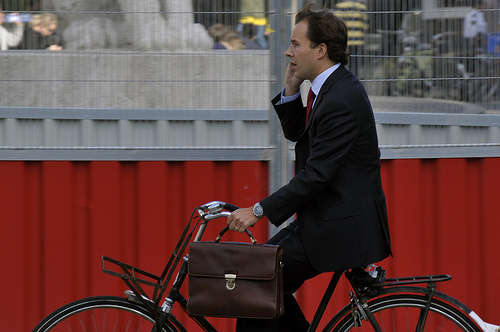
Photo by Amsterdamize
Fully upright is the best position for cycling. Don’t let anyone convince you otherwise. They’re only trying to sell you a bike that’s less comfortable in exchange for maybe a tiny percentage of gain in leg-effort or some other power dynamic that you won’t ever consider while you’re actually riding a bike.
No, I wouldn’t want to tour fully loaded on an upright. Other riding positions have their usefulness, but nothing beats upright for every day cycling. I find myself wishing for a taller stem on my Raleigh to make it more like my bakfiets and here is one reason why: when I wear a suit on a bike I want it to fit like it does when I’m standing or sitting at a desk. When I ride in even the most moderately “aggressive” position, my clothes lay taut against my back instead of hanging on the frame of my body. That means my shirt is clinging to my sweat when I want it to be moving loosely around me like it would if I were off the bike. Or riding upright.
*Finding a fully upright Dutch-style bike in this country is not an easy thing, I know. Even the big name hybrids out there lately are closer to the positioning of my Raleigh 3-speed than to a Dutch bike.
Filed under: bakfiets, commute, Dutch | 4 Comments
Tags: bakfiets, bicycle, bike, clothes, suit, upright
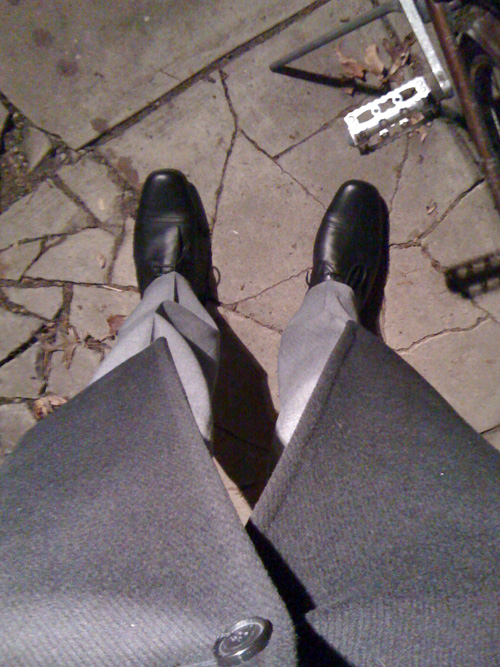
It really is.
Don’t let the cold fool you. Better still, don’t let everyone around you fool you. You will be called crazy, repeatedly.
Here’s what I wore cycling to and from work today with a high of 34 degrees. Same thing I would wear any other day. No special shoes; no pants tucked into my socks; a three-quarter length overcoat. It’s that easy. It’s even easier if the roads are clear. Maybe you have to go a little slower and watch for ice patches, but you get the added benefit of the cold flattening your hills because you won’t sweat nearly as much, if at all.
I’m a warm person, so I never need to dress differently than I would any other day. You may need a thicker sweater. Or long underwear. But nothing you can’t wear through a work day or take off if you get too hot indoors.
It’s not Olympic alpine skiing. It’s just riding a bike in the cold.
Filed under: commute, Winter | 6 Comments
Tags: alpine skiing, bicycle, bike, cold, commuting, cycling, Winter
Riding home tonight, in the dark, I come to an intersection and stop. There’s a guy and his dog in the crosswalk. The opposing traffic is stopped, waiting for him to cross. One of the two lanes of cross traffic is also stopped, waiting to turn right.
Only the cross traffic in the opposite lane, about to turn left, isn’t stopping. There, doing whatever he pleases, is Old Man Driver. He’s turning directly into the crosswalk, about to run down crosswalk Guy and his dog.
Guy, pointing at the paint in the street: “There’s a crosswalk here!”
Much hand waving from both Guy and Old Man. Then Old Man Driver rolls down his window. It’s 15 degrees outside, so he had better have something good to say.
Guy: “It’s a crosswalk! I’m in it!”
Man: “I can’t be expected to see everything!”
Guy: “Then you shouldn’t be driving!”
Man: “You’re a whore!”
Only he used a modifier in front of whore which in a more literal context would suggest the guy in the crosswalk was at least competent in that line of work.
Old Man drives off. I turn to crosswalk Guy with that look you share with people in these situations and he says, “and that guy’s my neighbor!”
Filed under: commute | 1 Comment
Tags: bakfiets, bicycle, bike, commute, crosswalk, old man driver

Oh, corporate America. You do have your ways. One of those ways involves moving me through four spaces in two years, all within a thirty-foot radius. In a 1400-person building. Like a hamster scratching out a path in cedar chips. At least the facilities guys will always have jobs.
So I took some things out, brought some things in.
At the top is a lamp and a picture going in; on the bottom is a chair and two lamps going in. That was a wet day, on the bottom. Heavy rain, but not a lot of wind—which, rain without wind can be kind of nice. I actually like riding in an easy rain.
In the rain is the one time when I get into cycling-specific gear. Any other time, hi-viz makes people look like construction workers who’ve lost their keys. Even at night, I prefer good lights. It’s the mesh tank-vests that kill it. Unfortunately, rain brings the visibility way down. Since we’ve a 50/50 chance any given driver will see us in broad daylight, I wear a hi-viz rain cape and spats in the rain. Spats!
Now, please, someone stitch together a cape in a fashionable color and run reflective piping through it in an unexpected pattern—you will corner the market on rain capes. Kill the neon yellow marshmallow. Maybe come up with a better name than “cape” while you’re at it. People who cycle to work in the States are generally nerdy enough.
A full rain suit—pants and jacket—is too sweaty. An umbrella isn’t practical with the hills or any wind. The cape alone leaves me with soaking, filthy shoes, even with fenders. So, yes, I wear a cape and spats and it’s the only thing that keeps me dry. I’m incredibly glad I don’t have a picture of myself in it anywhere.
It’s a British style; it goes with their Raleighs. It’s meant for a position slightly forward on the bars. Henry Cutler has written that they don’t work with the upright Dutch bikes, so I was expecting a mess when I rode in, but it wasn’t the case. Worked just like it usually does. Could also have been the canopy blocking a lot of water.
Still, riding in the rain is generally pretty great, even with the ridiculous wear. Most of the time we have rain, it’s light enough to wear any jacket. It’s also rare that on a day I go in under the rain, I come back home under the rain or vice versa.
Anyway.
The chair and the lamps came from an Ikea trip we made earlier in the week. We had a classic eye-rolling moment in the parking lot. We came early because we brought the kids, so we got a spot in one of the rows near the entrance. We’re coming up to our car—two shopping carts, two toddlers, half a dozen boxes—when someone trolling for a space stops and turns on their blinker. We haven’t even unlocked the doors at this point.
You can fill in just how long it took to unload and how accordingly long that car sat with its turn signal on while other cars queued up behind it. Even accounting for the Home Depots of the world, you are going to do a lot of walking in an Ikea. What’s another couple hundred steps in the parking lot?
Filed under: bakfiets, commute, Dutch, My Bike, rain | Leave a Comment
Tags: bakfiets, bicycle, bike, canopy, rain, rain cape
Crane Bell Co.!
I was up at the best bike shop in the country as far as I know and I found this bell. This is a BELL. Like they took it from a minature boxing ring. Listen to that sustain! Made in Japan. I love it when their good bike stuff gets through to us.
(This is not my video.)
Filed under: commute, My Bike, parts, Useful Things | 2 Comments
Tags: bakfiets, bell, bicycle, bike, Crane Bell, Harris Cyclery, Japan
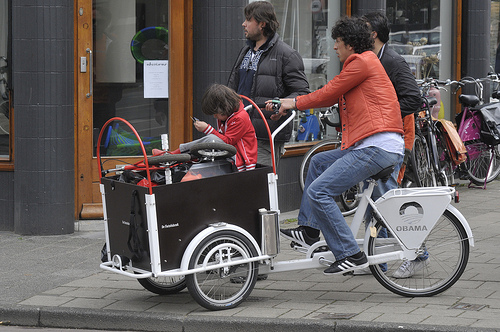
Photo by Amsterdamize
The Wall Street Journal ran an article yesterday in which much puzzlement and a fair amount of scorn was directed toward the Dutch for not wearing helmets. From the lede on through, the implication is the Dutch are fools not to wear them and it is only a matter of cultural stubbornness that they don’t.
While the author spends a number of column inches debating the merits of helmet effectiveness and whether or not people dislike the way they look, what he fails to highlight is the one reason they are unnecessary in the Netherlands: they have the world’s safest streets.
The Dutch are solving their safety issues by addressing the disease, rather than the symptoms. They have the safest streets in the world because they build traffic-calming structures, they don’t subsidize the cost of fuel and parking, and their laws place heavy liabilities on drivers, among many other things. They have chosen to reshape their transportation environment instead of suiting up for battle and hoping to come through unscathed.
In the States, we do very little of that. It’s the reason the number one cause of death among children under 14 here is traffic accidents (traffic accidents don’t even make the WHO list for causes of death among children in the Netherlands). Our roads are incredibly dangerous, yet we are loath to address the underlying causes. We couldn’t even get congestion pricing passed in Manhattan.
I have ridden in the Netherlands and I can anecdotally say it was the safest, most enjoyable experience I have ever had on a bicycle. I never once felt threatened by cars or trucks the way I did when I rode in New York.
Sure, the case can be made that in a fall a helmet will protect a rider and Dutch people do fall off their bikes from time to time. But they, like us, have made collective choices about the limits of their safety. Our cars have seatbelts and airbags, but no one is selling a sedan with a roll cage and a five-point harness or headroom for a NASCAR helmet. Certainly those features would prevent deaths and injuries, but we choose not to drive with them because we accept the risks. We enjoy the convenience of not having to zip ourselves into a fire suit when we want to buy groceries. Why should that be different for the Dutch on their bicycles?
P.S. Downhill skiing and cycling for transport are really not comparable activities (re: the article). I see this all the time when people write about helmet use. Urban cycling is a plodding affair. You are lucky ever to exceed 10mph, unless you are one of the X Games-style guys who give us all a bad name. Downhill skiing happens on snow and ice with grades of 30-40% at speeds in the neighborhood of 20mph+. To bring back the auto racing metaphor: a straight highway full of cars at 55mph is nothing like a racetrack full of cars at 200mph, which is another reason why you don’t get into that fire suit for your groceries.
P.P.S. David Hembrow has written critically about the Zeeland campaign referenced in the article. He’s a great advocate of the Dutch system.
Filed under: bakfiets, cycling infrastructure, Dutch, legal | 6 Comments
Tags: bakfiets, bicycle, bike, Dutch, infrastructure
All-day bakfiets
What does a day look like if the bakfiets is your car? It looks pretty much like any other day, only maybe you need a little extra time to get it all done because you’re going to be a little slower about it. What did I have to accomplish on Halloween?
- Take the kids to lunch
- Pick up prescriptions
- Get candy for trick-or-treaters
- Find a replacement toilet seat
- Look for new sheets at the mall
- Buy a travel guidebook
- Do grocery shopping for the week
- Get to and walk in the Halloween parade
Easy.
11:00 am

Kids in the bike. We’re off for pizza lunch.
11:30 am

Pizza lunch! Eating in the box is 100% more fun than going inside.
1:00 pm

Bring the kids home for a nap. Go to the pharmacy for prescriptions and candy.
1:45 pm

The mall. The dread pirate mall. I will take a detour here about why the mall was a short-sighted, very bad decision. It already feels antiquated to think of transplanting the suburbs into a city like this.
It does bring high-density retail to downtown but it puts it in a dead, private space instead of working it into the fabric that’s already there. Certainly it brings in tax receipts, but if I drive up from out of town, park in the garage, and never leave the building, am I adding anything to the life of the city? Or am I just generating numbers that look good on a spreadsheet?
My least favorite aspect is the new roads it brought with it. Gone is the one-way city grid, replaced by four-lane highway funnels. While the speed limits are the same on all these streets, everybody drives twice as fast on the new roads than they do on the cobblestone. The wider the street, the faster people will try to drive, regardless of where it is. Faster streets mean less street-level retail, less on-street parking, less pedestrians = more mall.
I found my toilet seat anyway.
(Plus: I will be in London on business in a few weeks and am meeting up with Mark of i b i k e l o n d o n for a tour and a ride, so stay tuned for that!)
3:00 pm

Shortly at the grocery store, but I have a question for you: when you drive, do you even see these signs? I don’t much understand them. When people ignore speed limits and begrudge stop signs, what are these getting done? I can hardly believe they mark recommended cycling routes; here they are planted on every major thoroughfare, which means they guide cyclists onto the busiest streets. Doesn’t make a lot of sense in a city old enough to have a basic grid so that you can ride parallel to these routes on calm, residential side streets.
3:45 pm

Shopping done. Heading back on the one dedicated bike lane on this side of town.
4:00 pm

Home. Unload.
5:00 pm

Halloween parade! G is a flower; R is a mushroom. We rode to the parade, milled around in the park, admired costumes, then bundled up in the bike for a walk in the parade. Rode home, despite the temperature having fallen what felt like 20 degrees in two hours. Probably the last trip without the cover until spring.
You can do this without your car. Your kids will love it. R&G ask to go on rides every day. I know this kind of thing won’t work for everyone, especially without infrastructure, but if you live in a college town or somewhere similarly sized with a bit of density, you can do it. Easy.
Filed under: bakfiets, Dutch, Kids, shopping | Leave a Comment
Tags: bakfiets, bicycle, bike, groceries, halloween, shopping, twins
 Bikes Can Work