Let us ride

Last month, a federal judge ruled with the NYPD to outlaw bicycle rides of 50 or more which go off without a permit in New York City. That’s code for the Critical Mass ride, which used to be the greatest time to be had on a bike in New York until the Republicans came to town in 2004 and killed whatever joy was left over after Giuliani.
The rides in the early years of the decade were some of the best times I had in New York. I will never forget the summer night we rolled through Times Square, hundreds of cyclists strong—everybody stopped in unison and many riders raised their bikes over their heads. People cheered. Tourists gawked. The cops held back traffic. It was unabashed fun. It didn’t last long; the ride moved on. But that moment will stay with me as long as I ride a bike because it was completely genuine.
Say whatever you want about Critical Mass. It’s a gelatinous idea, so your criticism or promotion will slosh around inside with the rest of it. That’s part of the charm and part of its derision. I never thought it was a particularly effective tool for protest. Nobody looks to a crowd of cyclists for that, not the way a crowd of marchers used to inspire change. Not everyone who rides is even remotely interested in cycling advocacy anyway. I would argue those people are the small minority. The rides are harmless fun at a casual pace and just about every other major city in this country seems to get and support that but New York. (I know SF has its perennial issues.)
It’s a shame, because New York is such a fascinating place to ride a bike. I’m sad to see this continuing to drag on and I am bewildered to see Time’s Up has estimated the city spent $1.32 million for two years to shut it down. Can anyone report on how the ride is today?
My last ride was the one in April of 2005 when that million and change was hard at work. The NYPD may not have killed it entirely, but they certainly made it incredibly unpleasant. I wrote a ride report for Stay Free! Magazine shortly after and rereading it now for the first time in years, I can still remember the helicopters—helicopters!—chasing us through Alphabet City as though we were extras in a straight-to-video sequel in the Batman franchise. It was definitely intimidating. But mostly it was weird. Weird and sad.
Filed under: Advocacy? | 1 Comment
Tags: bicycle, bike, critical mass, giuliani, New York, republicans, rnc
American cycling infrastructure
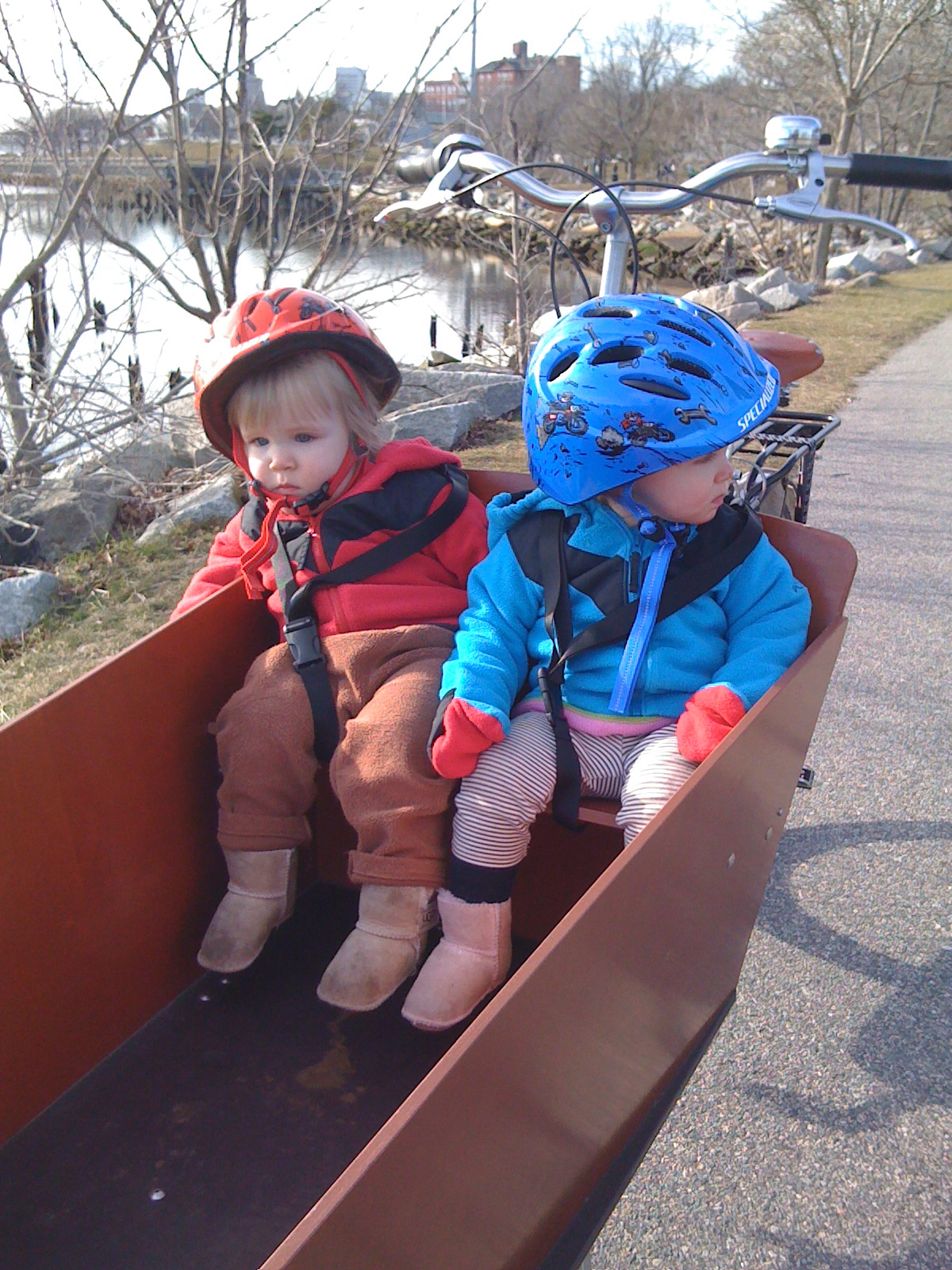
Still winter, but the weather this weekend is brilliant. Sunny and 50’s. Not spring, though. Nobody say it’s spring because we’ll all get our hands slapped with a week of snow and 20-degree wind. March was only spring for the Romans because they lived in the Mediterranean. Somehow that hasn’t been cleared up in New England yet.
G & R & I had our longest ride to date: a solid two hours of singing, napping, dog-spotting and napping. We hit the main drags, detoured through downtown, then along the river and out into the newly rebuilt waterfront park. We even had time to ride a few miles on the bay path, which is a lovely, lovely ride but like all the lanes and paths here, ends unceremoniously by dumping cyclists into heavy traffic. Our cycling facilities are recreational first, useful a distant second.
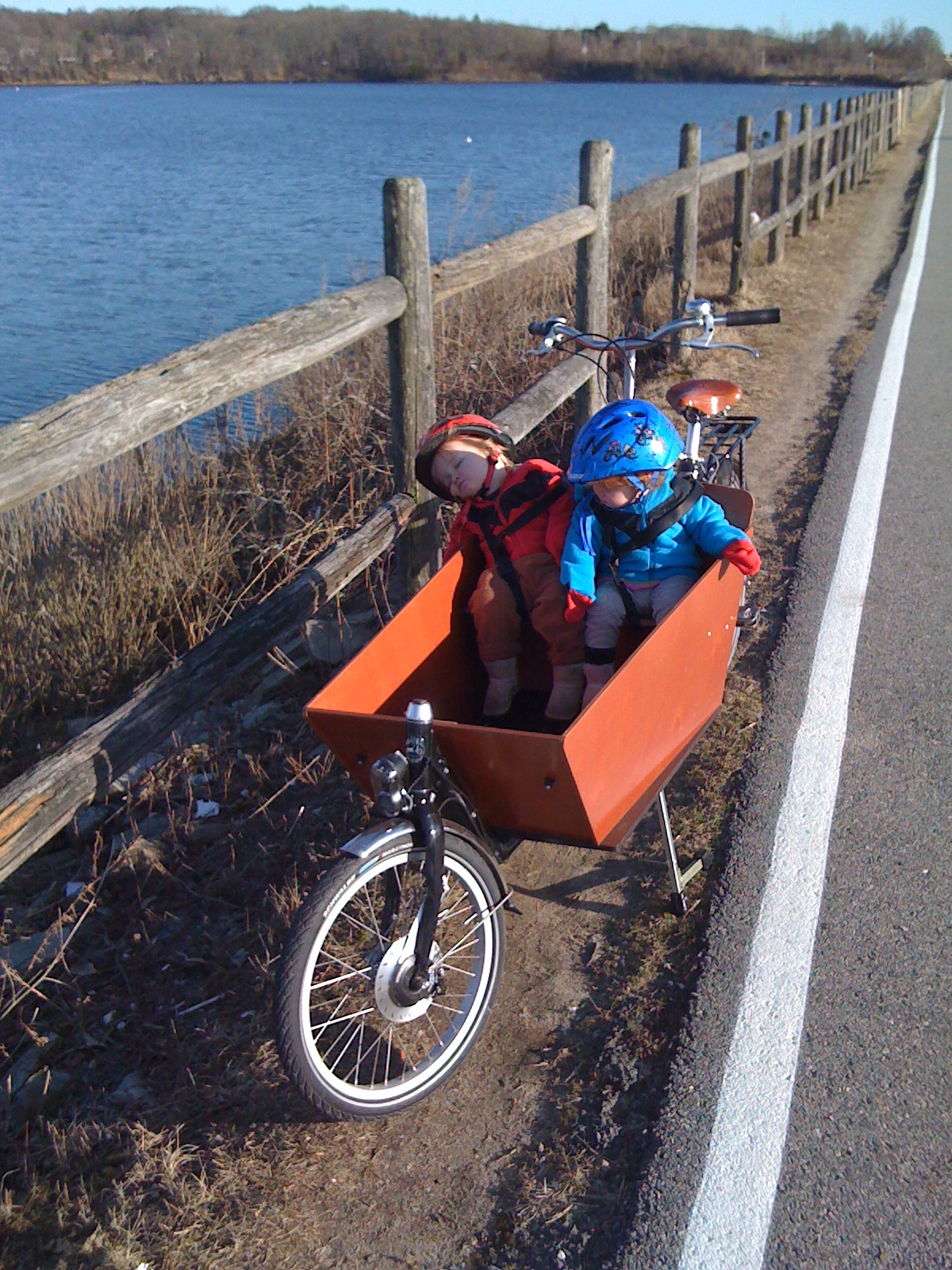
By now the sun had set so that the wind off the water was cooling and picking up speed. It never got bitter, but cheeks were turning and home had crept to the top of the itinerary. The ride back was as enjoyable as the way there, except for one unpleasant stretch in the middle:
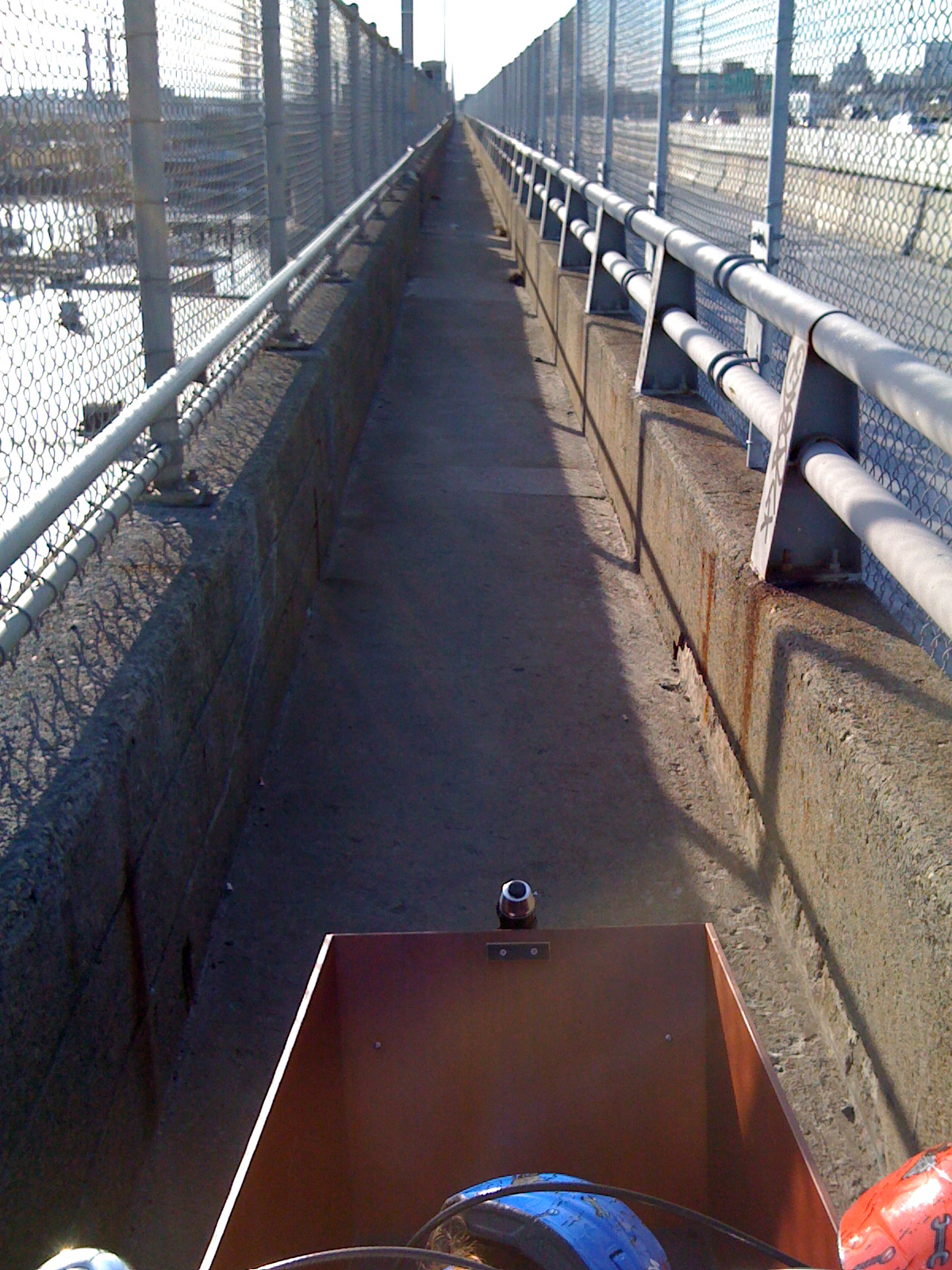
This is the expressway bridge over the river and the only practical route from the city to the bike path along the bay. (Not only does this let out into heavy traffic, it also adds a street full of glass under an overpass.)
The shadows in the photo make it look wider than it is. You can only pass another cyclist by each walking your bike. No one can pass the bakfiets. There are a handful of tiny “lookouts” into which opposing riders have to duck and wait for me to go by. You really have to concentrate in order not to hit the walls. It’s great.
The alternate route includes crossing a bridge which used to become a highway, so of course everyone drives over it as though it still does. It forces you out right into its exit ramp and then you have to race to cross a stream of traffic coming up a hill and around a blind corner. You finish down a 12% decline, which coming back up I have to push my Raleigh. I’m not sure I could even push the bakfiets up.
The state has plans to rebuild the expressway bridge—wider, benches, less like a prison yard—but nowhere in those plans is a provision to keep any of it open while the work is being done. They’ll likely shut it down on the first day the weather hits 70.
This is really the only link between the city and the path. Nobody goes the alternate route because it’s a deathtrap. If it closes entirely, people from this side of the bay will have no choice but to rack their bikes and drive to the first lot along the path. Hardly makes sense, having a path system which at any time encourages people to drive in order to ride their bikes. But that’s what we get when our town and city planners believe a bicycle is not a transportation device.
Filed under: bakfiets, Kids, My Bike | 2 Comments
Tags: bakfiets, bay path, bicycle, bike, cycling infrastructure
Robin Hood


Filed under: street bikes | Leave a Comment
Tags: bicycle, bike, robin hood, street bikes
Hallo, bakfiets!
If you want, the bakfiets can take the place of a car. That’s what it does. You don’t need to live in a place without hills. You don’t need Dutch cycling infrastructure (although I wouldn’t turn it down). You need only a fair amount of urban density and the patience to ride a bike more slowly than you would otherwise without the box. After that, the bakfiets does all the work.
“Bakfiets” is a compound Dutch word which translates literally to “boxbike.” It’s a generic term that can describe any number of cargo bikes you might see in the Netherlands. This particular bakfiets is a modern version of the Northern European freight bicycle known as the Long John, characterized by a load carried low and forward of the rider, with a small wheel at the front. Maarten van Andel designed this version in Amsterdam in the early part of the 2000s in order to bring what is traditionally a commercial bike down to the scale of the family.
It’s built by Azor Bike in the Netherlands, is exported by WorkCycles in Amsterdam, and comes to the States through a handful of dealers, most of whom are on the West Coast. I got mine from the good people at Clever Cycles in Portland, OR, who were very kind to extend their remodeling sale to me. No dealers currently on the East coast, but the Dutch Bike Co. of Seattle and Chicago is advertising plans to open a shop in Brooklyn sometime later this year.
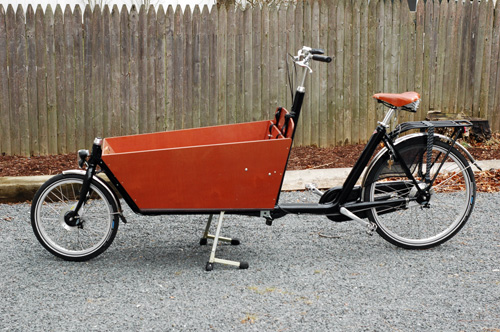
The bakfiets is heavy-duty but it’s not cumbersome. For eight feet of bike, the ride is remarkably balanced whether loaded or not. It rolls like a locomotive on tracks. It puts your toddlers to sleep. On your first ride, don’t look at the front wheel, look where you want to go and you’ll have it figured out before you turn around. The steering is exceptionally sensitive and that can take a little getting used to, but everything else is just like riding a bike.
The bottom bracket is low and the seat tube is angled back, which puts the rider in a very comfortable position, one in which she is sitting upright and can easily place a foot on the ground without getting out of the saddle. It’s lovely whenever you stop, but it’s especially beneficial if you ever lose control—getting a foot on the ground to regain your balance becomes a reflexive act. The upright position and high handlebars also means the rider supports no weight on her hands, leaving her upper body free to relax.
It is made to live outdoors, day and night, all year long and for many years. Very few people in Amsterdam have the space to bring a bakfiets indoors, so they are chained to racks and railings and left to fend for themselves. David Hembrow has a video tour of the Azor factory, which at the 2:55 mark shows the salt and steam bath they use to test durability. The wood is marine grade. The bike is engineered to last like a tank. Have at it.
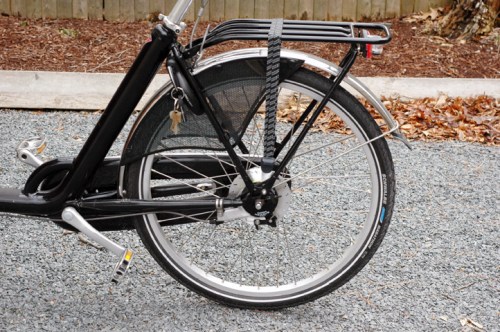
Above are all the hallmarks of a Dutch bike: a skirt guard to keep dresses and overcoats from tangling in the spokes; an o-lock, bolted to the frame—its steel ring immobilizes the rear wheel when the key is removed; a fully enclosed chaincase; fenders; an incredibly bomb-proof rack, smartly designed with the tail light mounted underneath so you don’t accidentally snap it off.
The hub is a Shimano Nexus 8-speed attached to a 17-tooth cog. I had assumed I would want a larger cog for a lower gearing overall but I have learned that even up the 6% hill from the grocery store, the bakfiets will go no faster than it does, no matter my cadence.
The brakes are drum brakes, not disc. That means the entire propulsion system is internal and the weather will never affect the bike’s mechanics (except for maybe frozen cables). On my Raleigh in the rain, the chain attracts dirt like a magnet and the caliper brakes need to clear the rims of water before they can really slow things down. On the bakfiets, that’s not the case. It’s more like a car, in which everything important is shielded beneath the hood.
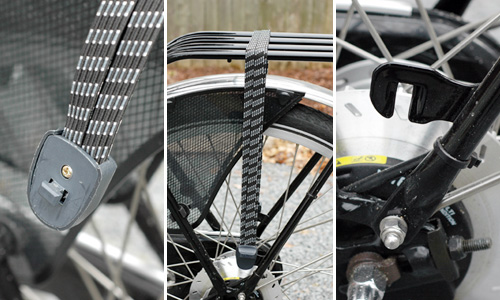
The Dutch ride side-saddle all the time, so their racks have to be exceptionally strong. The most I’ve yet to strap on is a double stroller and I forgot it was even there once we got moving. The bakfiets comes with an elastic made to fit in the slot welded to the rack, but any bungee hook will work there. It’s wide and long enough to accommodate whatever you can balance on top of it.
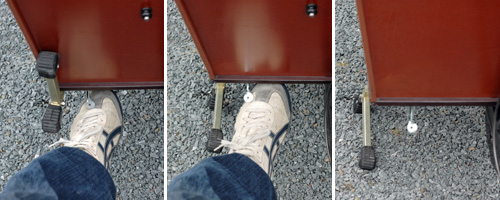
A bike built to transport this much cargo needs to be rock solid when loading and unloading. Accordingly, the kickstand is more like a built-in repair stand. Here’s how it works. (1) With the stand down, the bike goes nowhere. Kids can climb on it. Heavy loads can be put in, taken out, and shifted around without any movement. I’ve even parked it on a slight lateral decline with no problem. (2) To bring the stand up, grab the handlebars from the left side and push the bike forward. The stand swings back on its hinge and the front wheel touches the ground. (3) Pull the leg of the stand up with your hand (or foot) and (4) engage the latch. When it’s new, the pad that keeps the stand from rattling (far left, bottom photo) is stiff. You’ll need to pull hard to get the stand to catch. As the pad wears, it gets easier to do it with your foot.
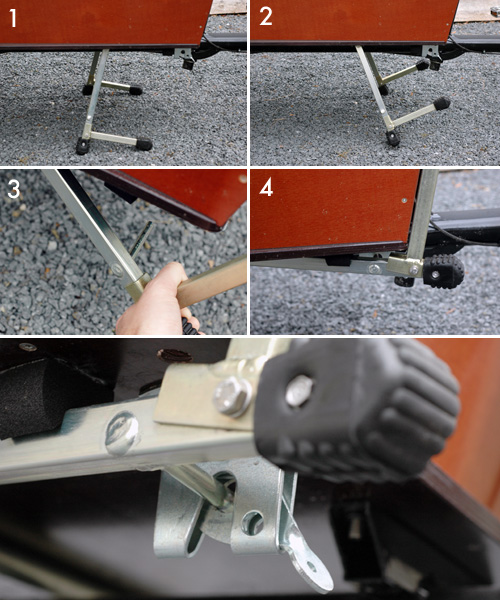
Bringing the stand down is done by releasing the latch with your foot. After the stand has dropped, pull the bike back to set the feet on the ground.
What can the bakfiets carry?
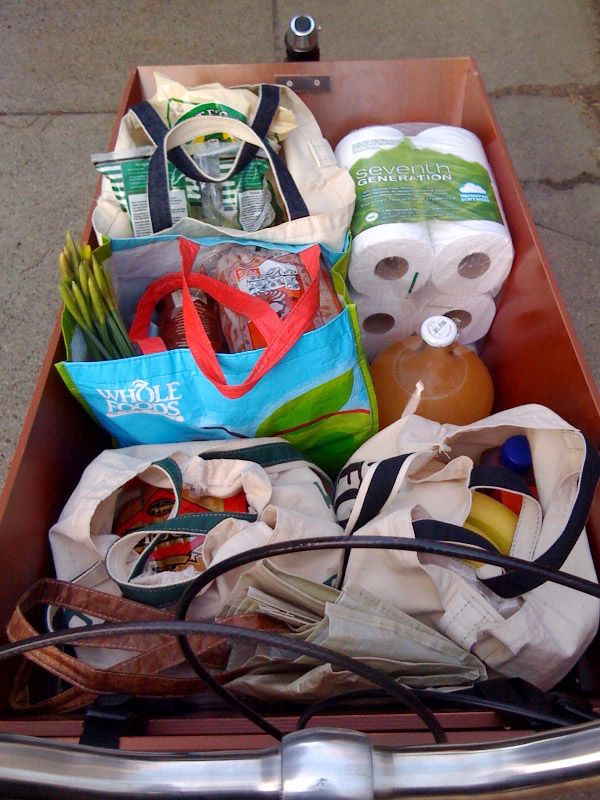
Children, of course. Junk. Boxes. Groceries. Rugs. A couch, a tree, a Christmas tree, and certainly then Mrs. Claus, or, even, everyone. Quite literally anything that marginally fits in the box or can be strapped to it or to the rack. You won’t win any races on the bakfiets, but you will get your things where you want them to go and you will do it without thinking. On a regular bike, you have to consider what’s most important on a grocery run and leave the rest for the next time. On the bakfiets, you can get the whole week’s shopping for four people in one trip, just as you would in a car.
It’s not a particularly expensive bike, as bikes go (it costs around $3000; compare that with an $8000 racing bike) and it’s a very good practical value for how much it can do. It’s ultimately no comparison to the cost of a car. No bike is. Even the cost of the most expensive utility commuter won’t get you a terribly decent used car. In fact, after totaling the cost of car insurance, property taxes, gas and maintenance, as a replacement for a car the bakfiets begins paying for itself after roughly twelve months (and that’s not even including car payments).
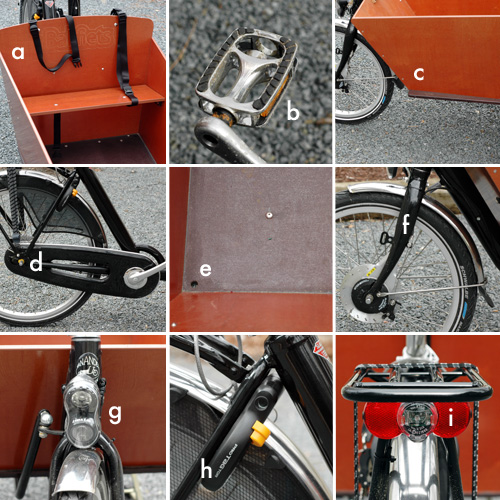
What else does it do well?
a. Bench and harnesses. Fits two kids (convenient for twins!) and straps them in against squirming. Probably will last until they’re four or five, at which point you can get a second bench to mount mid-box or somebody can sit on the floor. It flips up when not in use.
b. Pedals. Grippy like a rat trap, only without the teeth. Friendly to cheap flip-flops.
c. Step. It’s this kind of detail which demonstrates just how refined the design of this bike is. The walls of the box are angled in just enough to create a lip out of the bottom panel. It’s a step for a child to lift himself into the box.
d. Full chaincase. No chain maintenance, ever. No greasy pants.
e. Drain holes. One in each corner so when you leave it out in the rain, you don’t have to cycle home with 20 gallons of water.
f. Generator and generator tab. Even though the bike comes with a Shimano dynohub, which powers the lights as you pedal, the fork is made with a tab to accept a bottle generator. You have options. (Maybe this is a stock fork which finds its way onto bikes without the Shimano hub?)
g. LED head lamp. Plenty bright for city riding. A nice, even beam. In addition to steady on, it has an auto setting which will switch the lights on when the sky gets dark. (Auto sensors on bike lights are really more gimmick than useful. They don’t activate until the sky is very dark and I want my lights on well before that time of night. Plus, this one picks up overhead streetlights so your lights go on and off as you pass under them.)
h. O-lock. Standard equipment on any Dutch bike. I have never understood why they are completely absent here. They’re perfect for locking up quickly during short stays. Much easier than chaining up to something, but you don’t want to rely on it overnight.
i. LED tail light. Stays lit for a few minutes after you stop.
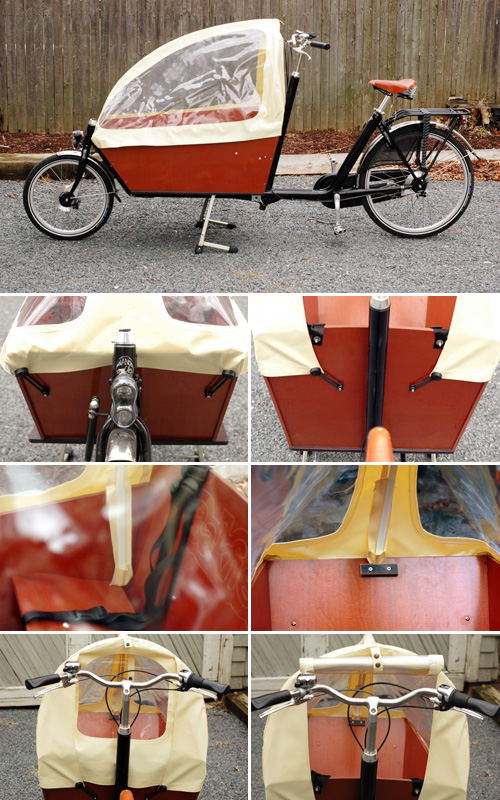
Finally, the rain cover. It’s necessary if you have kids and want to use it all year. Not only does it protect from the rain, it also keeps out the wind and warms the inside like a greenhouse in the winter. It’s not quite a hassle to put on but it’s certainly not the easiest thing to negotiate when loading two toddlers. It fits tightly against the box and is fixed by four thick elastic loops. Its skeleton is two curved plastic strips: one runs the length of the cover in the middle and the other forms the arch near the handlebars. You might expect that you could unhook one of the rear corners and flip the cover up and over in order to unload a kid, but the plastic ribs make that a little awkward. You basically have to take it most, if not all of the way off. It’s unfortunately not a hatch.
G & R and I went for a Sunday morning ride this past weekend. I didn’t get any pictures, but they were out after the first ten minutes which I consider to be as positive a review as any. We’re looking forward to a lot of trips and picnics along the bay as the weather turns (if it ever does!) as well as runs to the museum, to the farmer’s market, to the doctor, to nana’s and babu’s, to the grocery store, to pick up dry cleaning, to visit friends, and just to ride. We’ll let you know how things hold up over time.
Filed under: bakfiets, Dutch, Useful Things | 7 Comments
Tags: Azor Bikes, bakfiets, bicycle, bike, Clever Cycles, drum brakes, Dutch, dynamo, internally-geared, long john, WorkCycles
Lap dogs
Did I miss a trend in US Weekly? I have seen a dozen drivers with dogs in their laps on my commute during the past few weeks. This morning I passed a woman at a stop sign with a terrier pressing its face against the driver side window. She was of course on the phone at the time. These aren’t toy dogs I’m seeing, either; these are pretty decent-looking small breeds. One of the drivers actually had a standard poodle with its head out the window. It must have been half on the passenger seat.
This is the kind of thing I think about whenever I hear someone say “well, until cyclists start following the rules of the road…” Which do you think is safer: a cyclist on a 40-pound bike treating a stop sign as a yield? Or a driver in a 3000-pound truck, on the phone, with a 20-pound animal in her lap?
Filed under: commute, Try not to do this | Leave a Comment
Tags: bicycle, bike, cyclists, dog, drivers, lap dog
Groceries
Filed under: bakfiets, Dutch, My Bike | Leave a Comment
Tags: bakfiets, bicycle, bike, groceries, shopping
50 degrees
Hour number eight of a terrible migraine and of course it’s Saturday, sunny, and the first 50 degree day of the year.
Filed under: Winter | Leave a Comment
Tags: bicycle, bike, sick, weather
Inside
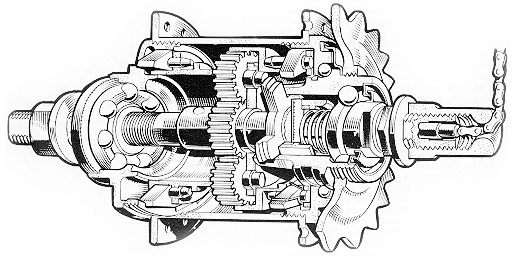
I love my Sturmey-Archer. It’s maybe the single most reliable mechanical thing I own. I am an unabashed proponent of internally-geared hubs. Alongside a dedicated cycling infrastructure, I think internally-geared hubs and chaincases are the two keys to getting more people to cycle regularly. I say that because I know people in this country don’t want to tinker with their transportation. About the only maintenance we do to our cars is fill them with gas. Tire pressure and oil changes are a very distant second, so why would anyone expect that we would want to deal with a misaligned derailleur?
So when Grant Petersen wrote a post about internally-geared hubs, which I have never seen him mention before, I took notice.
(An aside on Petersen, for those who aren’t familiar with him: He was a designer and director at Bridgestone for many years in the ’80s and ’90s, pushing in opposition to every trend in cycling in favor of what was simple, useful and time-tested. Many of the frames they produced during his tenure are still highly regarded; a good friend and neighbor of mine rides his every year. After he left Bridgestone, he started Rivendell, which does a lot of what he did at Bridgestone, only without the corporate interference. They have been around since 1994, which is an incredible feat for a niche bicycle maker and a testament to Petersen’s business skills and vision. He’ll even personally reply to your ill-informed emails about the bikes they make, like he did to mine years ago. Not to mention that rarely a week goes by when they aren’t donating some portion of their profits to charities like the Smile Train and the Fistula Foundation. They are all around good people. I bought my road bike from them. I am getting way off track.)
What did he say? He prefers a derailleur to an internally-geared hub because if it breaks, he can fix it. He doesn’t agree that having exposed mechanicals necessarily means they will get gunked up and fail. He hasn’t had an Amsterdammer show him how to fix a flat without taking off the wheel (he didn’t say that). He doesn’t write the hubs off for what they are, and while it isn’t in their best business interest to do a bike around one of these things, they haven’t ruled it out entirely.
I think that’s a perfectly fine place to be on internally-geared hubs—basically preferring what you know—but what I don’t understand is this fear of catastrophic hub failure. You can see it in the two reader emails he appended as post scripts as well. Is it really true that these things are such delicate flowers?
My experience with my Raleigh says that the reason the woman in Portland isn’t seeing many Sturmey-Archers in her shop is because they so rarely fail. I have left mine in the rain and snow and cold for eight years and I have never brought it in for repair. Who knows what it was doing for the twenty-five years before that. That is a singular experience, of course, but I would also wager that if a bike in the Netherlands isn’t single-speed, it’s got an internally-geared hub, and it isn’t coming in from the weather, ever. I don’t believe the Dutch have ever trended away from hubs and chaincases and they have the world’s most dedicated cycling population, so if it’s working there, it works.
The point I want to get to is if people are going to ride in much bigger numbers here than they do presently, they are not going to care if a derailleur is more straightforward than an internally-geared hub. They’re not going to want to touch either. So get the hub. Let’s assume for the sake of argument that the Shimanos don’t last. What would you rather do? Wrestle a greasy chain every few weeks or never have to think about your drivetrain for three or four solid years until you have to take your bike to a shop?
Filed under: Dutch, Techy | 2 Comments
Tags: bicycle, bike, grant petersen, hub, internally-geared, rivendell, Sturmey-Archer
Hand made
I didn’t understand cycling caps until very recently. I thought the bills were for show and the style was for Bushwick hipsters, but it turns out they’re just as practical as a ball cap in the outfield. In the winter, about all I ever wear is a wool cap with earflaps from Walz. It keeps the sun out of my eyes and the cold off my ears. I’m a pretty warm person generally, so I only add a balaclava on the days it gets into the low teens.
They’re a tiny operation in San Diego. I swear their website used to have a picture of Mrs. Walz at a sewing machine in her living room cranking them out, but it’s not there anymore. They have probably grown since, but all their stuff is still made in the US and done by hand. I can attest to that—the bill on my cap isn’t straight. And I like it. Recommended.
Speaking of micro-scale, handmade in the States: Acorn Bags is another operation worth mentioning. I have their small rear bag on my Raleigh for my tools and tubes and assorted junk. It does just what I need it to do and not much else. I can’t speak to their larger bags because I haven’t seen them firsthand, but the craftsmanship on this tiny bag is excellent, so let’s extrapolate.
They’re a husband-and-wife team and nobody else. They used to post notices about how many weeks the wait would be to get a bag; it generally hovered around seven to eight. Now they just post all the stock they’ve made the previous month and then go into hiding to crank out another month’s worth. If you don’t want to wait for Carradice and their flaky export schedule and you believe in domestically-produced goods, Acorn Bags is it.
Filed under: Useful Things | Leave a Comment
Tags: acorn bags, american, bicycle, bike, handmade, local, walz caps
Take it with you
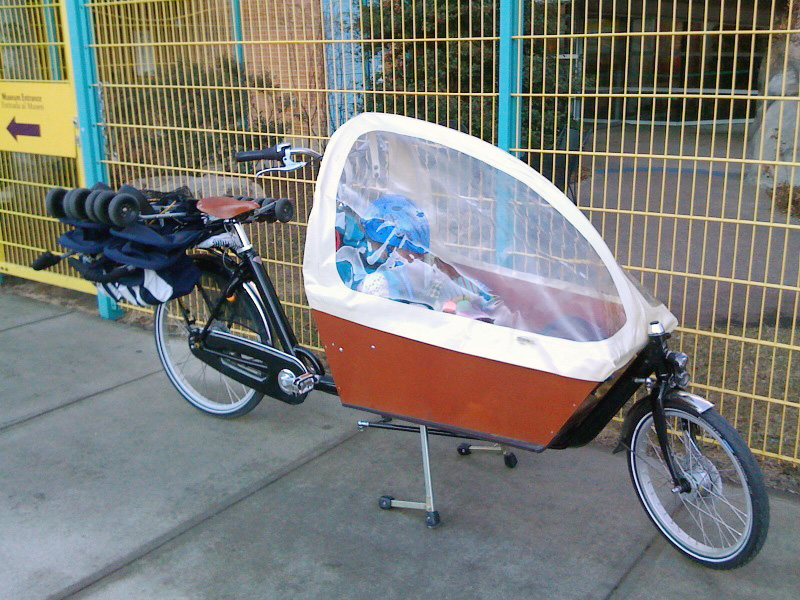
At fourteen months, the twins aren’t yet walking enough to go anywhere without a stroller, especially if only one of us is taking them. It’s winter and the wind is gusting to 35mph today, so the cover is on to keep their faces from turning pink. With the cover on, you can’t carry anything in the box that would otherwise protrude because the cover fits on tightly. So the stroller goes on the rack.
The rack is majorly tough. It’s not like anything you’d find on an American bike, unless its racks are Tubus or a similarly heavy-duty import (Surly probably makes a good one, come to think of it). It’s also simple and smartly designed. It has two tabs welded to its arms made to hold the hooks of a bungee cord. (They’re squared off to fit exactly to a standard Dutch elastic, which comes with the bike, but they do just fine with a bungee hook).
When I put a bungee on the aftermarket rack on my Raleigh, I have to hunt around for the best curve to hook onto and hope it doesn’t slip on the ride. With the bakfiets rack, I don’t have to think. The hooks go under the tabs and the load has all the room it needs to balance, no matter how unwieldy.
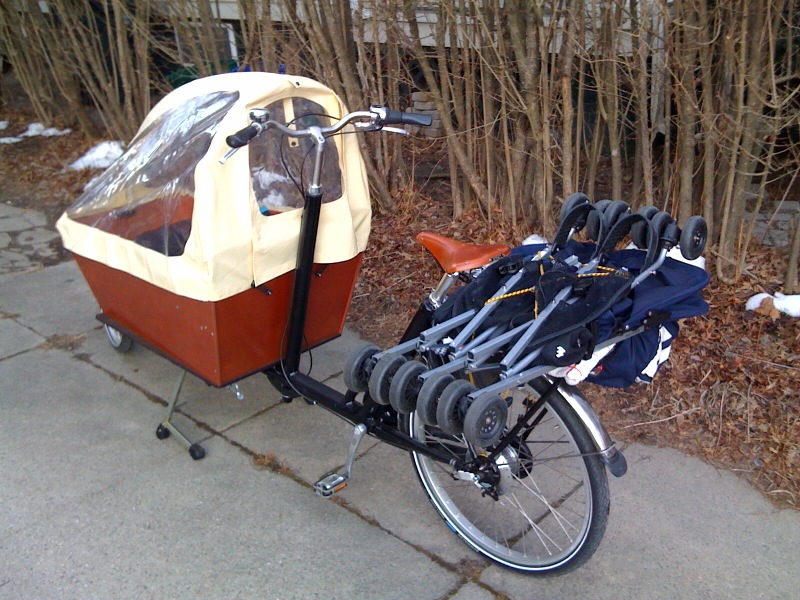
G could care less about any of these things…

Filed under: bakfiets, Dutch, Useful Things | Leave a Comment
Tags: bakfiets, bicycle, bike, bungee, rack, stroller
 Bikes Can Work