Snow power

Modern bottle generators are quiet, reliable, efficient, and cause relatively low drag. They can slip in the rain, but I’ve never had any issues with mine when it’s wet. My tires have a grooved band for the generator wheel to grab, so everything stays pretty much where it should be.
This morning, however, I discovered where these generators come up short: snow. You can see to the left how little was on the roads, but it was enough to kick up under my fender and rain back down on the generator wheel, stopping up the works. My light up front would flicker, then go out as long as I was in the snow. Fortunately, everywhere cars had been was clear and after a few seconds on that pavement, the snow would shake off and the generator would catch again. Riding in this kind of fresh snow on my bike is fine, but I can’t fit studded tires on my wheels so any deeper and I can’t ride.
All this is an argument for a dynohub, like any in the Shimano line. A dynohub is a replacement for the hub in your front wheel. Like a bottle, it generates electricity as it spins but it exposes none of its mechanical parts to the elements and so works in any conditions and needs no adjustments. They’re twice as expensive and they also come with the cost of having a new wheel built, but they will power your lights for many hundreds of hours without you ever having to think about them.
Filed under: commute, Winter | Leave a Comment
Tags: bicycle, bike, generator, lights, snow, winter commuting
Find the blinky
Do yourself a favor and get real lights. Just get them. Spend $50 on lights for your $25 bike. You will thank me on the days you don’t get run over. You can blow through a stop sign at the bottom of a 10% hill on a fixie with no brakes as long as you have bright, steady, well-mounted lights.

This rider pulled into the grocery store tonight while I was locking up. The arrow is pointing to the world’s tiniest LED. Maybe it once had a lensed cover and it broke off? Does it even matter if it’s tucked under the saddle and behind the reflector?
Filed under: Try not to do this | 1 Comment
Tags: bicycle, bike, blinky, LED, lights
Doppelgänger

I was in Amsterdam this past fall when I happened on my bike’s Dutch doppelgänger on one of the 9 Streets. It’s an earlier model than mine; I’m guessing 1950’s because of the chaincase. It’s been well maintained and has gotten a lot of use, if the additions are any indication. Over time someone has taken this quintessentially English bike and made it Dutch.
The fork is a replacement, which probably means it was once in a head-on crash. This is a testament to the durability of steel, that the frame survived unscathed. The stem has been swapped for a longer one in order to get the bars into a more upright riding position, Dutch style. The rack is an add-on, as is the rear wheel lock, which is standard on every bike in the Netherlands. The bottle generator up front is clamped to the fork with a part similar to what I have on my seat stay. Usually if a generator goes on the front fork, it’s attached to a braze-on mount with a vertical opening made especially to hold a generator against the force of the turning wheel.
Finally, the lights: one mounted to the headset and one on the rear fender. The saddle is new, too, but it’s the same Brooks model the bike would have shipped with 60 years ago…
Filed under: Dutch, My Bike | Leave a Comment
Tags: 3-speed, Amsterdam, bicycle, bike, Brooks, doppelgänger, Dutch, Netherlands, Raleigh, repair
What makes a bike useful?
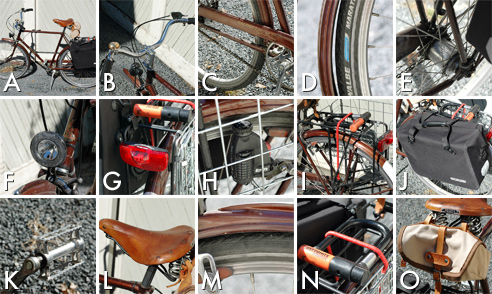
What makes a bike useful? If you can ride on wet pavement and not get wet; if you can ride at night and be seen; if you can ride with two bags of groceries, your bike is useful. If it is an analogue for a car, then it is useful. If you can ride it to and from work or out to dinner. If you can take your kids on it. If you can go shopping.
This is a blog about what makes a useful bike. I hope in this space to write what I know about bikes and what I learn while I ride them most every day. I’ve never been a mechanic and I don’t have a deep practical bicycle knowledge, but I’ve been riding long enough and often enough that I’ve found what I think works and what doesn’t.
This is my city bike, the bike I use for commuting. It’s a ’77 3-speed Raleigh Sports to which I’ve done a fair amount of tinkering over the years. Older model bicycles like this were made to last but still need a little help to be fully modern and practical. Here are fifteen things about it which I think make it useful.
A. Frame
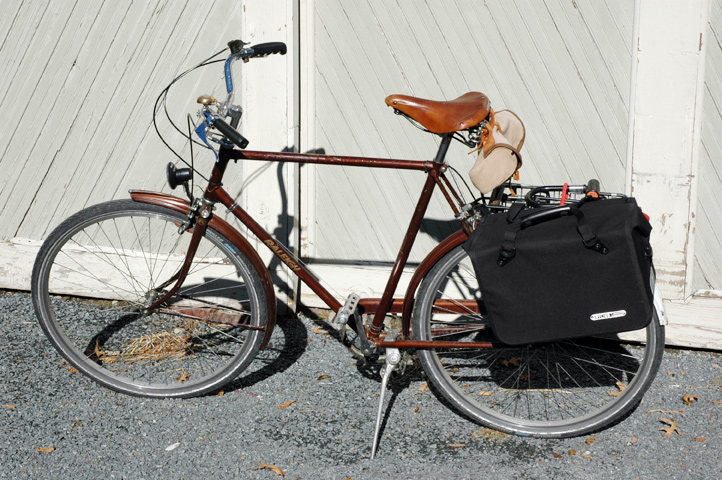 When racing took a singular hold on bicycle manufacturing, weight became the only measure of a frame’s worth. I am sometimes asked how much my bike weighs, the subtext of which is: how can you possibly get around on that tank? The answer is I do it casually because weight isn’t much of a concern to me. Unless you race bikes for a living, frame weight shouldn’t matter to you, either.
When I talk about a useful bike, I necessarily mean a bike that will last a lifetime. Every pound of weight savings off a frame is a trade against durability and longevity. The lightest frame materials are the least durable. If you crack your $5000 carbon fiber frame, you will have to find an expensive, specialized repair shop and hope the damage is minimal. If you bend or crack a steel tube, you can bring it to any frame builder or welder and be back on the road for a few hundred bucks.
Another shortcoming of the weight obsession is a frame in this context is always considered without its rider. If you are comparing two frames, one which weighs 10 pounds and one which weighs 20, the salesman will tell you the 10-pound frame weighs 50% less. But this is a fallacy in the real world because you aren’t considering your own weight on the bike. Assume you weigh 200 pounds. Now you are comparing a cycling setup weighing 210 lbs vs. one weighing 220 lbs, which at this point is a 5% weight differential. Is a 5% lighter bike worth the cost of replacing it 10 or 15 years sooner than the heavier model?
B. Handlebars
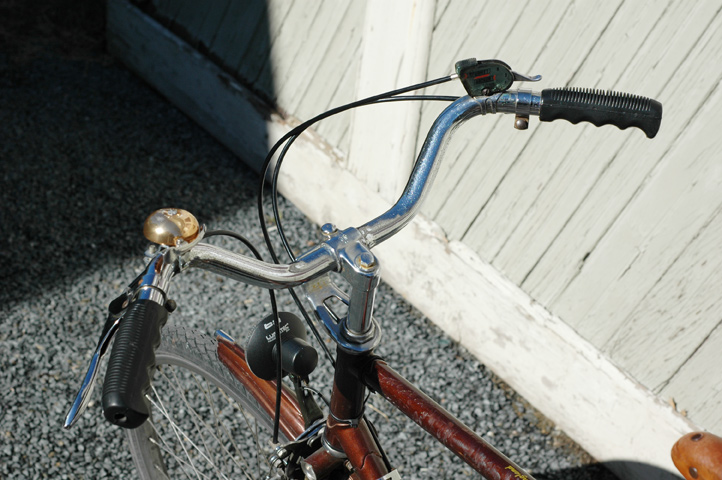 Nearly every bike for sale in America today has a threadless headset. It was a development which allowed manufacturers to use one fork on many bikes which had previously required individual forks. Costs went down, but riders lost a lot of flexibility. A threadless stem cannot be adjusted significantly once installed and nearly every one of them is installed at a height optimal for speed, so the rider is hunched over.
Fortunately, a few manufacturers stick with the threaded headset and quill stem, which lets you raise and lower your bars with ease and over a range of many inches, but most importantly gets the bars high enough for an upright sitting posture. Bikes made before the late 80s will have this setup. Sitting upright is your key to comfort, being able to see the traffic around you and enjoying the view.
(I have a bell on my bars. Bells are worthless unless you live in the Netherlands, the only place on Earth where people take them seriously.)
C. Chainguard
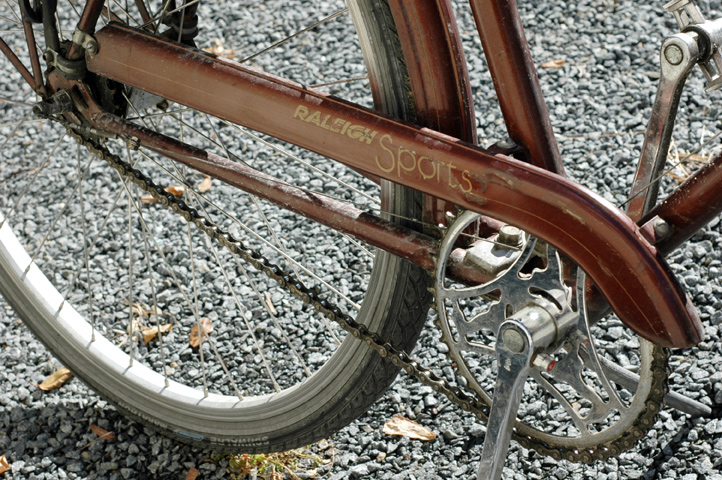 A useful bike is a bike which can be ridden in whatever you’re wearing. That means if your pant legs go down to your shoes, they should stay there. If you have to roll them up or tie them back, then your bike is not the useful it could be. You can’t do this without a chainguard or a chaincase.
D. Fenders
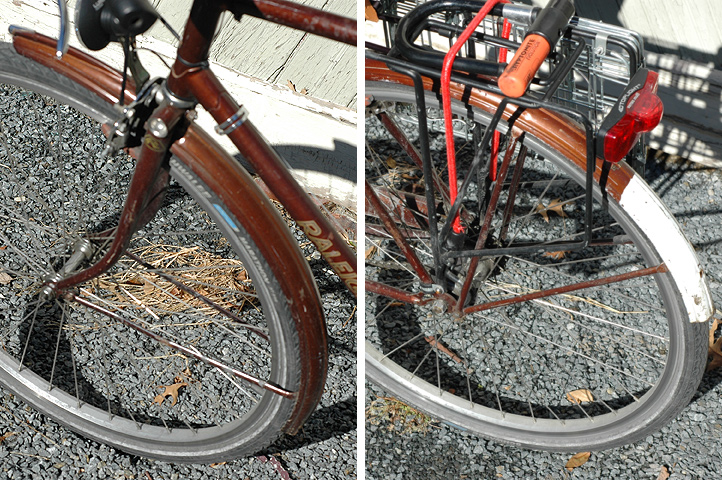 Fenders are second only to lights. You practically couldn’t even get a bike without fenders up until the point at which racing stripped everything useful off them. Fenders keep you dry. They keep the spray from a wet road out of your face and off your back (and out of the face of the rider behind you). SKS makes a great set out of recycled plastic. You also have fancy options. Just don’t get the kind that clip on to your seat post. Get full fenders.
E. Internal-Gear Hub
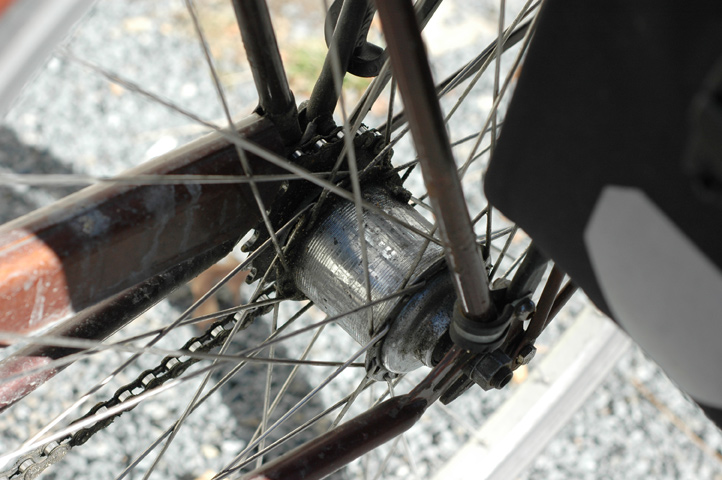
Gearing is another perennial bike conversation. It’s the sister sales tool to frame weight—more gears equals more better. Gears are lovely on the open road, on club rides or touring, but around town when you’re maxing out at 12mph, nobody needs more than eight. My Raleigh only has three and 95% of the time that’s all I need. One is pretty tough unless you really want to work.
When you have that few gears, you can package them inside a hub and shield them from inclimate weather and dirt. You no longer need a deraileur, so your chain becomes fixed and will never have the opportunity to jump off your rings and leave you with greasy hands at the side of the road (if you have a bike with a deraileur, this has happened to you, I guarantee it). This is the beauty of the internally-geared hub. It renders your drivetrain maintenance-free. I do nothing but squeeze a couple drops of oil into my Sturmey Archer when I remember to and it has never, ever failed. My bike is 33 years old.
F-G. Lights
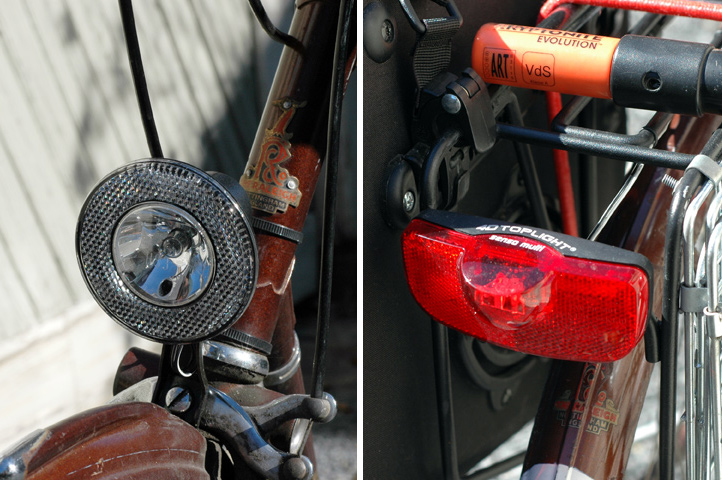
Lights are the single most important component on your bike. Spend extra on them. I ride through the winter, which means most mornings and every evening I need lights.
My head lamp has saved me from more accidents than I can count. I don’t think blinkies in back are great, but definitely don’t use one up front. People crossing from side streets will not see you if you aren’t shining steady in their face.
Go with a big, solid tail light. I swear, drivers will give you a wider berth if they think you are riding a scooter or a small motorcycle. Make sure it’s mounted on a rack or a seat stay. I see people all the time with blinkies clipped on shoulder bags where the light is mostly covered by the bag flap and the rider doesn’t know it.
H. Generator
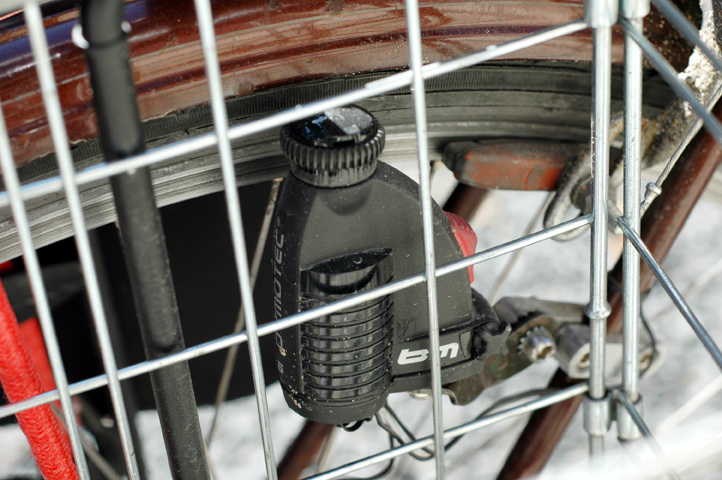 I only recently made the move to generator-driven lights. You can get great quality battery-powered lights but you’ll eventually be cursing on a narrow shoulder because your head lamp died and you don’t have spare batteries anywhere. Peter White is fond of saying the difference between a toy bicycle and an adult bicycle is generator-powered lights (I’m paraphrasing here). He’ll then ask whether you would get into a car at night without automatic lights and if not, why would you do that on your bicycle?
Bottle generators are vastly better than they used to be. Setting one up with lights on an older bike like this is easy and relatively inexpensive, considering the benefits. My lights and generator are Busch & Müller and cost about $150 altogether. They are reliable and made to stay outside all the time. On new bikes, look for the Shimano hub generator.
I-J. Rack & Bag
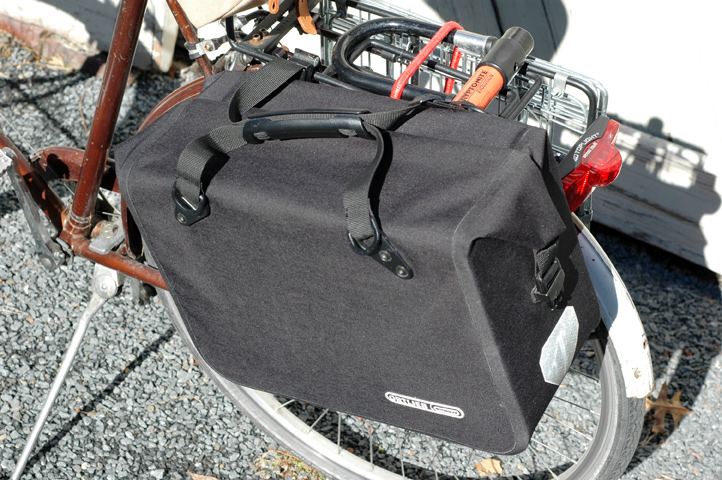 A bike isn’t practical if it can’t carry anything other than you, so get a rack or a basket up front. Sure, you can sling a bag over your back, but riding unencumbered is just about a thousand times more pleasant. A frame with rack eyelets is best because the rack will mount to them and never move. My bike doesn’t have them, so I have to clamp it to the seat stays. It’s not ideal and it wobbles under heavy loads, but it gets the job done. On one side I have a fold-up Wald basket (very handy for beer) and the other side I keep free for an Ortleib pannier. It clips on and off in half a second, has a roll top so is completely waterproof, and has a handle and feet so you can carry it and set it down without it flopping over. It is black and boring.
K. Pedals
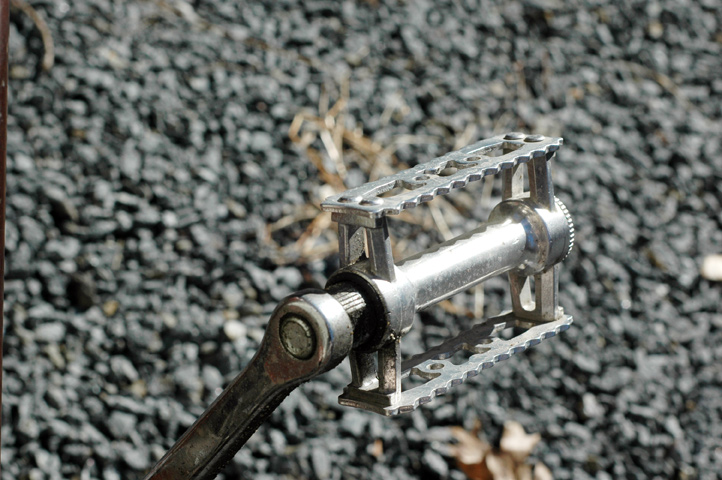 Ditch the rubber bricks that come standard on these old bikes and spend 20 bucks on a pair of MKS rat traps like these. Even if you never ride in the rain, you will one day ride the day after the rain and your wet soles will skid right off those toothless blocks and you will lose control just a little bit. And you won’t like it.
L. Saddle
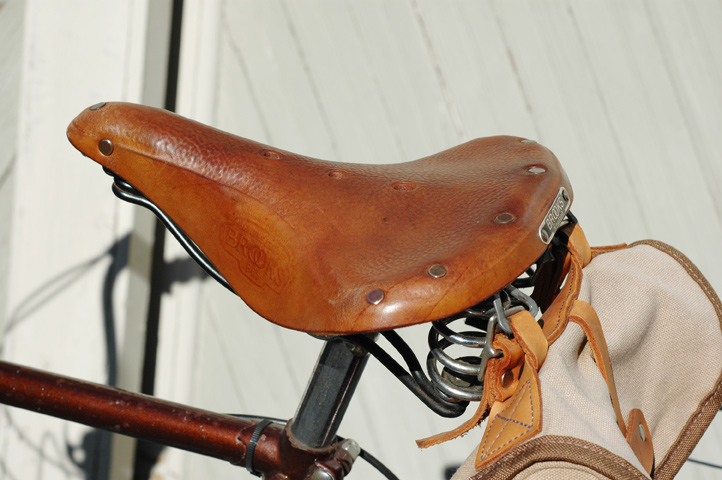 Don’t let anyone rope you into a conversation about how well a particular frame material rides. It’s a mostly ridiculous concept, but someone somewhere will try to convince you that titanium is way less harsh than aluminum. Doesn’t matter. All you need are wide tires—38mm and up, but not knobby—and a sprung saddle. That’s your suspension.
M. Tires
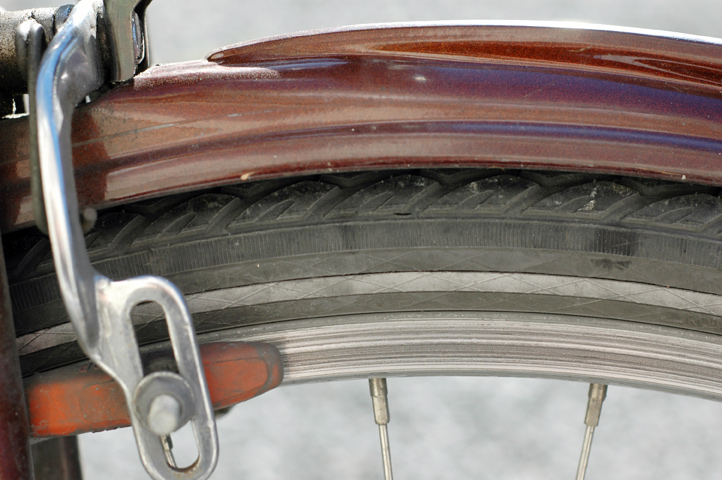 Not all tires are the same, like most everything. Cheap tires will wear more quickly, so if you commute every day, spend the money on a pair of Schwalbes or something comparable. Schwalbes are great because they build in two features especially for the practical cyclist: a reflective stripe on both sides which screams when headlights hit it (the grey band above the brake) and a ridged band for a bottle dynamo to grip (you can see it in the enlarged photo). I use both.
N. Lock
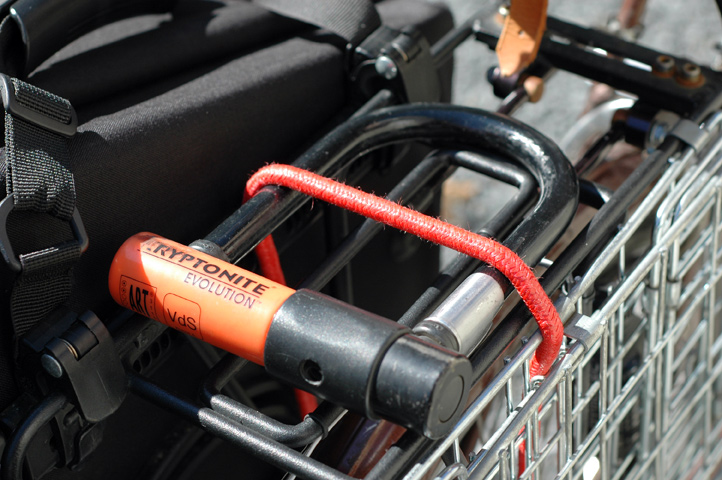
Conventional wisdom says a thief will steal the bike which is easiest to take, so as long as your lock is better than the bike next to yours, you’ll be fine. Every neighborhood is different. I never carried anything less than a 15-pound hardened chain when I locked up in New York, but your local criminals may be gentler. A quality U-lock is plenty in most places. The smaller ones are better because they give a thief less opportunity for leverage when attempting to break it. Just don’t ever use a twisted-strand cable lock. They can be cut with a good pair of kitchen shears.
O. Tools
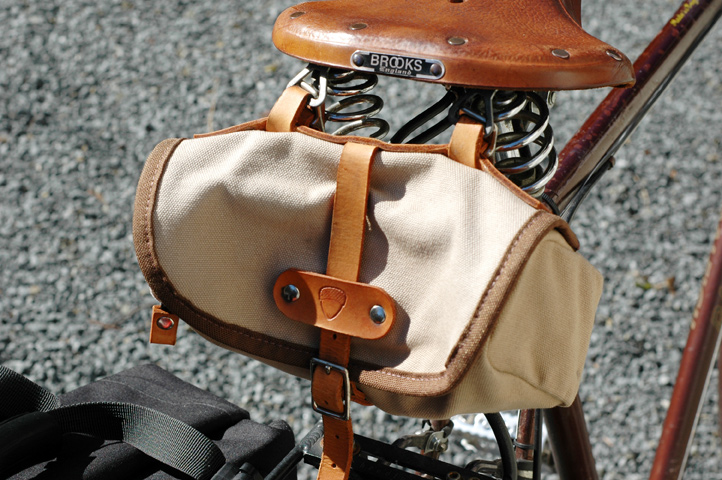 Learn how to fix a flat. The only maintenance you need to know is how to oil a chain (less is more) and fix a flat. If you ride every day, you will eventually get a flat on the open road. To fix it, you’ll need at least to have tire irons, a patch kit and a pump. I keep mine in a saddlebag. Bonus points for learning to fix a flat without taking off the wheel. (Everything else is for your local bike shop. Do give them the business.)
Filed under: My Bike, Useful Things | 6 Comments
Tags: bag, bicycle, bike, blinkies, commuting, components, fenders, generator, handlebars, hubs, lights, lock, pedals, rack, saddle, tires

 Bikes Can Work